All situations
Built for engineering teams

Engineering roles that stay open too long.

The comfortable explanation is scarcity: the people do not exist. The uncomfortable one is that they exist, they are findable, and your funnel starves because every serious evaluation costs hours only your senior engineers can spend.

Free 14-day trial with 3 New Roles and 12 Credits. No card required.
Supply, measured

The scarcity story does not survive contact with the data.

We can say this with unusual confidence, because mapping engineering populations is a thing we do in public. If entire org charts can be reconstructed from the outside, the engineers you want are not hidden. They are enumerable.

56,861
engineering and research professionals x-rayed across 15 U.S. AI-compute and chip companies
3,041
OpenAI engineers profiled, the full population
1,281
Anthropic engineers and researchers, same treatment

The same reports explain why these people never appear in your inbound: the AI-compute study found roughly one in seven of NVIDIA's engineers effectively locked in place by unvested equity. Present, skilled, and not applying to anything. The frontier-labs flow map and the quant crossover study trace where they move when they do.

The real constraint

Evaluation is priced in the hours you cannot buy.

Walk through what one serious candidate costs: a recruiter screen, an engineer's phone screen, a take-home someone senior grades, a panel that burns an afternoon, prep and debrief on top. Every hour comes out of sprint capacity, from your strongest people. Teams respond rationally, and every rational defense starves the hire.

Rational defense one

Keep the funnel narrow

A wide funnel multiplies evaluation load, so the funnel gets throttled to exactly the width the team can afford to evaluate. On a hard role, at that width, the trickle of genuinely strong candidates rounds to zero.

Rational defense two

Batch around releases

Interviews cluster into the quiet weeks. Between clusters, interested candidates cool off and take other offers, and the search restarts from a colder state than it paused in.

Rational defense three

Let keywords make the cut

The recruiter's keyword filter costs no engineer time, so it makes cuts it is not qualified to make. The engineer whose last three years match your problem, in a different stack's vocabulary, never reaches a human.

This is why the role stays open. Not scarcity: rationing. The cost never appears in the recruiting budget, which is why the diagnosis keeps landing on the haystack instead of on the hours.

Precision, measured

Spend model compute before you spend engineer hours.

If evaluation hours are the scarce resource, the leverage is in what reaches them. This is measurable work, and we publish our measurements: Mira-Embeddings-V1, our recruitment-domain reranking study, on a pool of 300 real job descriptions.

Retrieval quality before and after domain-adapted reranking, from the Mira-Embeddings-V1 study
BaselineMira-Embeddings-V1What it means at your budget
Recall@5068.89%77.55%More of the right people inside the set a human actually reviews
Precision@1035.77%39.62%Fewer wasted first looks at the top of the list

Retrieval tuned on generic web text does not do this: the engineer you need may sit under job titles you would never think to search, and keyword search fails in precisely the searches that matter most. Sourcing runs across 860M+ profiles in more than 190 countries, per the published funding announcement, which matters because the best-fit person is employed somewhere you were not looking, not applying to anything.

From bar to booked panel

Your bar, run continuously, with evidence attached.

  1. 01 The bar, written to decide Your team · once Not the posting: the decision document. What someone must have done, what disqualifies them, what the first call should establish. Your best interviewer's head, on paper. Retrieval and screening run against the bar, not against keywords.
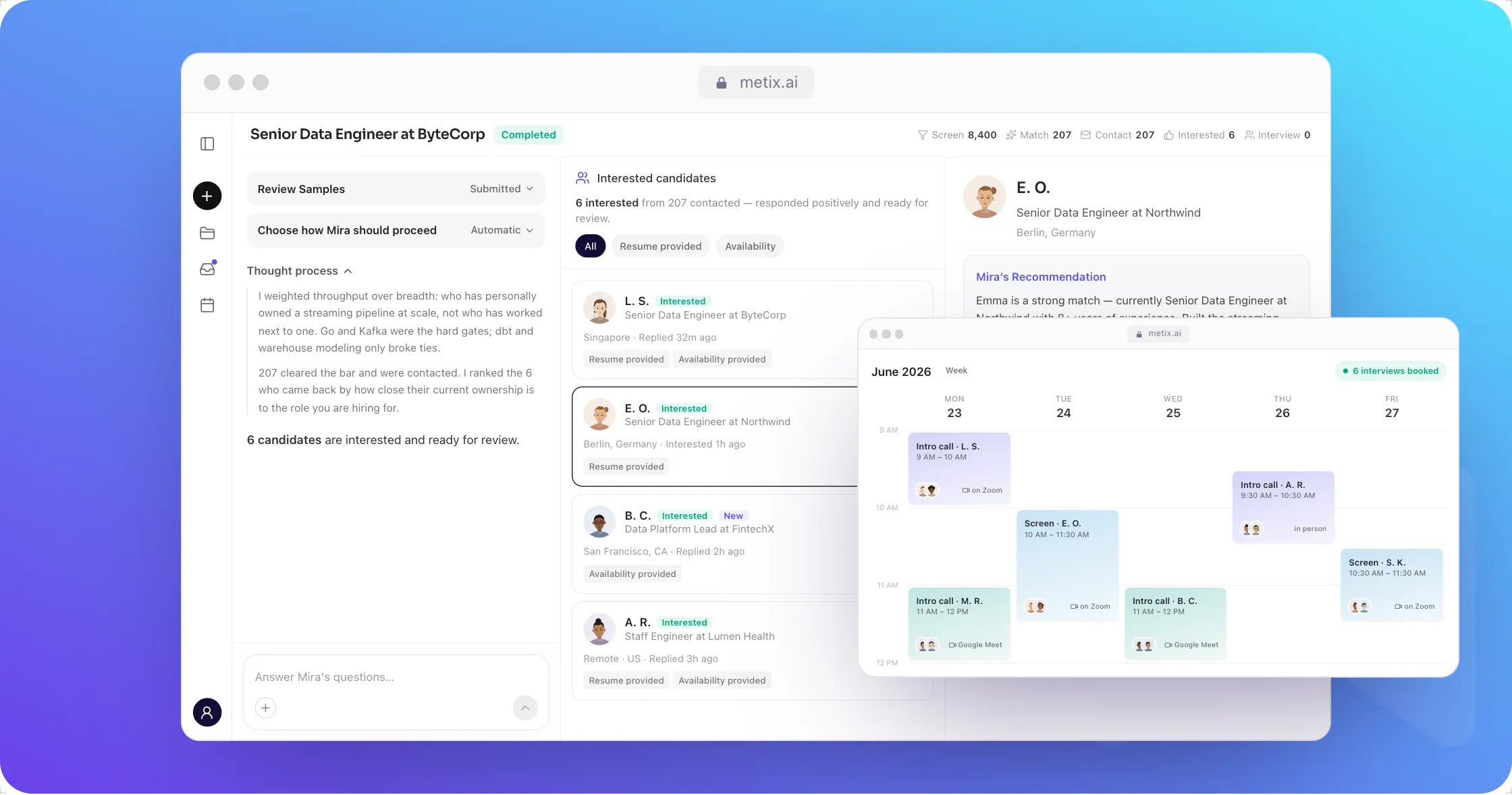
  2. 02 The pool narrows on model time Mira · before any human hour Retrieval tuned on recruitment data surfaces the people the keyword filter cannot parse, and outreach reaches the employed engineers who never apply. A delivery lead reviews the survivors before your panel is involved.
  3. 03 Evidence assembled, interest confirmed Delivery team How the person clears the bar, on which skills, plus confirmed willingness to move. Counteroffer shoppers and polite maybes are filtered here, at zero engineer cost. Confirmed candidates book directly against your panel's real availability.
  4. 04 Senior hours spent as decisions Your engineers The panel opens the call knowing why the person is in the room. Evaluation capacity goes to judging signal instead of filtering noise.
The usual fixes, measured

The two usual fixes, and why they keep not working.

Both standard fixes share a root failure: neither changes who pays the evaluation cost. One sends noise to your engineers, the other sends it through a middle layer first. Specialist technical search firms are a real exception for executive hires; our fee analysis covers when that price is justified.

Metix AI
Inbound + job boards
Generalist agency
Reaches employed non-applicants
Yes: outreach across the graph
Samples everyone else
Within their network
Who makes the first cut
Screening against your bar
A keyword filter
Someone who cannot evaluate the work
What reaches your engineers
Booked interviews with evidence
The applicant pool, raw
A longlist, invoice attached
Evaluation cost
Spent on signal
Spent discovering the mismatch live
Same hours, plus the fee
Cost shape
Per delivered candidate, from $49/mo
Cheap until you count the hours
20 to 25% of first-year cash
Strong Partial Weak

Noise never reaches the panel.

Senior hours stop paying for the filter and start paying for the decision.

See pricing A zero-qualified month spends zero credits
The boundary

What this does not replace.

Still yours

The technical interview

Nothing we ship evaluates whether someone can build your system under your constraints. That judgment belongs to your engineers and stays with them.

Still yours

The close

Strong engineers weigh teams, problems and equity. The persuasion that lands them is yours to do, and no delivered candidate closes themselves.

Still yours

The calibration

If the bar is wrong, the funnel is wrong. We make a miscalibrated bar visible faster; you still have to move it.

For the skeptics

The evaluation bill, itemized.

What one serious candidate actually costs

The evaluation bill deserves one more pass, because no budget line ever shows it.

Recruiting spend sits in one column, sprint velocity in another, and the transfer between them, senior hours flowing into first-round evaluation of mismatched candidates, appears in neither. A cost that no report captures is a cost nobody is assigned to reduce, which is how it survives every planning cycle. A panel afternoon is three to five engineer-hours before prep and debrief, and the people spending them are the same people the roadmap is waiting on.

Nobody is making a mistake on the day they make it. The batching defense looks especially sound in isolation, and it quietly resets the funnel each cycle, because interested candidates do not stay interested across a release freeze.

Contrast the status quo interview with the delivered one. In the status quo, the panel discovers fifteen minutes in that the candidate has never touched your stack, and three senior engineers spend the remaining forty-five minutes being polite. With evidence attached to the booking, that hour either does not happen or happens on purpose.

Interest confirmed, calendar booked, and why both matter

Two properties of the handoff carry more weight than they look.

Interest is confirmed before booking, so the panel never burns an hour on someone quietly shopping for a counteroffer at their current employer, which every engineering manager has done at least once and remembers. In the engineering market described by our AI-compute report, where a meaningful share of strong engineers sits behind unvested equity, willingness to move is exactly the thing a profile cannot tell you. A screening conversation can.

And the booking is a real calendar slot, not a "candidate is open to chatting" note that costs a week of scheduling email before any evaluation starts. Time zones, reschedules and the follow-up chase all happen inside the loop rather than in your coordinator's inbox. The metric this page cares about is senior engineer hours per advancing candidate, and scheduling friction is part of the spend, whether or not anyone accounts for it that way.

One writing note that pays for itself: the bar is a different document from the job posting. A posting is written to attract; a bar is written to decide, and the two diverge exactly where hiring goes wrong. The posting says five years of experience; the bar says has debugged this class of failure in production and can explain the fix. Your interviewers already carry the second version in their heads. Writing it down once is what lets a screening loop apply it at volume.

One limit worth naming: stage-time measurements for technical searches are not something we publish yet. The retrieval numbers above are measured and public; the stage-hour claims are not, and this page treats them accordingly.

What the population x-rays actually tell a hiring team

The supply reports are not decoration for this page. They are the evidence behind its central claim, and they change how an engineering search should be scoped, in three specific ways.

A note on method first, because the method is what separates these reports from vendor hand-waving and decides how much weight the numbers can carry. Each x-ray reads the full current population of a company as data: every engineer, not a sample, profiled on seniority, tenure, skills, sources and education. The reports publish their counts and their cut dates, so the claim "the people exist and are enumerable" is checkable against the reports themselves rather than against our say-so.

First, enumerability. The OpenAI x-ray profiled the company's full engineering population from the outside: seniority, tenure, skills, sources, education, for all 3,041 people. The Anthropic report did the same for 1,281. If that reconstruction is possible for the two most-watched employers in the industry, it is possible for your target market, which means "we cannot find anyone" is a claim about your funnel, not about the world.

Second, reachability. The one-in-seven finding about NVIDIA engineers behind unvested equity describes people who will never appear in any applicant pool, and who become movable on vesting schedules, not on your posting schedule. A search that only samples applicants structurally misses them, no matter how good the job description is or how wide the posting is syndicated.

Third, direction. The frontier-labs flow map and the quant crossover study trace who feeds whom, name by name, across 13 labs and 25 quant firms. Flows tell you where your next hire is likely working today, in which direction the current runs, and roughly when tenure and vesting make a move plausible, which is a better scoping input than any keyword list a recruiter could assemble.

Pick the role with the graveyard

Take the role with the graveyard of almost-fits and write the bar as your best interviewer thinks, disqualifiers included. Then track the one number this page has been about: senior engineer hours per candidate who advances past the first interview. Not applications, not screens completed. If the delivered candidates do not clear your real bar, you have spent nothing and learned whether the bar, the market, or we are miscalibrated, and the evidence will show which.

FAQ

Questions before you start.

Can Metix AI evaluate specialized engineering skills?

Mira screens against the hiring bar you approve: required skills, seniority, domain background and the questions you would ask in a first call. The published Mira-Embeddings-V1 study covers how retrieval is tuned on recruitment data specifically. What Metix AI does not do is replace your technical interview; it ships the screening evidence with each booked candidate so your engineers spend their hours on people already worth the hour.

Where do engineering candidates come from?

Sourcing runs across 860M+ profiles in more than 190 countries, per the published funding announcement. It is not limited to people active on one network, which matters for engineering searches where the strongest candidates are rarely applying anywhere.

How fast do first interviews land for a technical role?

The published commitment is qualified, interested candidates booked onto your calendar, with a delivery lead reviewing each one before handoff. Speed depends on the bar and the market, and the honest way to test it is the free trial: 14 days, 3 New Roles, 12 Credits, no card, on your actual hardest role.

Open for a quarter?
Test us in two weeks.

Your bar, run continuously, with evidence attached to every booked interview.

Free 14-day trial with 3 New Roles and 12 Credits. No card required.