The strange thing about cross-border hiring is where it fails. Not in the search: the person exists and is reachable. It fails after they say yes, in the gap between an accepted offer and a legal, paid employee.
Every team that tries international hiring eventually lives the same sequence. The search half works: the skills you could not find locally exist in Porto, or Bogotá, or Warsaw, at compensation your budget can carry. The offer goes out; the offer is accepted. Then someone asks the question nobody owned: how do we employ this person?
Modern sourcing reaches across borders as easily as across town. The candidate exists, is reachable, and will usually take the conversation. This half has stopped being the hard part.
Entities, contracts under local law, statutory benefits, payroll and withholding, termination rules that differ everywhere. Opening a subsidiary to employ one engineer is a months-long project with lawyers.
Recruiting products stop at the offer. Employment products start at the contract. The candidate has a start date, a competing offer, and weeks of "we are figuring out how to employ you" in between. That seam is the failure mode.
The joint announcement with Deel calls it closing "the last mile of recruiting": Metix AI users access Deel's Employer of Record services and payroll infrastructure, powered by Deel's white-label solution, directly through Mira. Access runs directly through Mira rather than through a referral link and a separate signup.
Compare the two-vendor version of the same hire: export from the recruiting tool, open an EOR account, re-enter everything, reconcile start dates, duplicate questions from two systems during the exact week the candidate is most likely to get cold feet. Every step is a place the hire can stall. The partnership was announced in July 2026; where the announcement is the source, this page adds nothing to it.
Employment-side pricing is set on the Deel side for the arrangement used, and this site does not publish those terms. Outcome pricing carries over unchanged: a credit is spent when a qualified, interested candidate is booked, never for activity. The boundary cases live on the outcome-pricing page.
Put yourself in the candidate's chair. A foreign company you have never worked for offers you a role. Version one: you will invoice us monthly as a contractor, our lawyer says it is fine. Version two: a local employment contract under your country's law, statutory benefits, proper payroll, a payslip your bank and your landlord both recognize.
Version two wins, and not by a little. Contractor arrangements push every risk onto the person you are trying to convince, and the candidates with the most options are the ones most likely to decline that risk politely.
The same logic applies to speed. An offer that can name the start date, the legal employer and the payroll mechanics in the acceptance conversation removes the weeks of uncertainty, which is precisely the window where competing offers land.
A search that reaches the right person in 190+ countries and then hands them an invoice template has spent all its quality in the first half of the chain and thrown it away in the second.
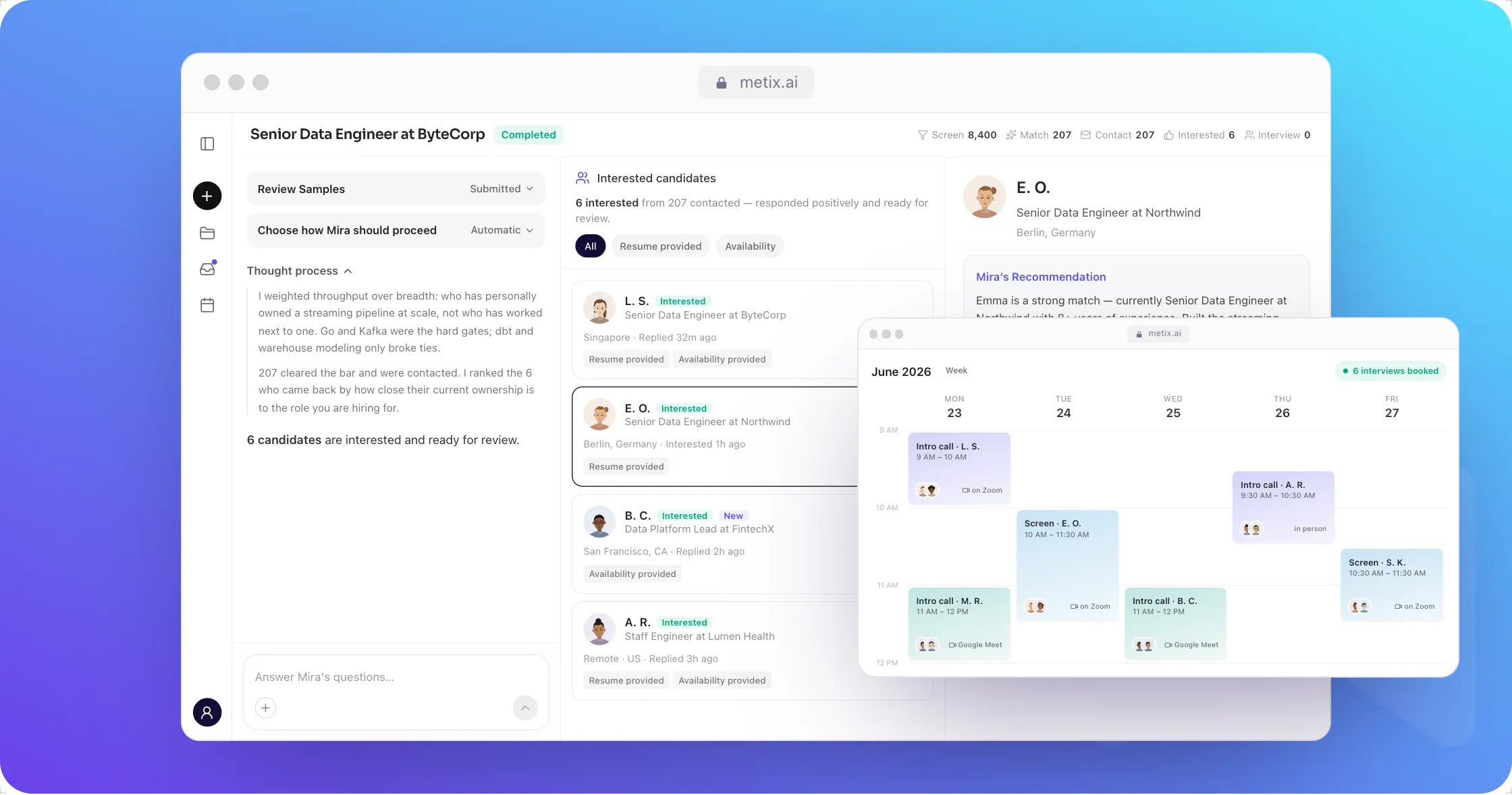
Interviews land on your calendar from wherever the best people actually are, and an accepted offer connects straight into compliant employment.
See pricing → The same published plans, wherever the search runsThe chain employs people in the country where they already hold the right to work. Sponsorship and relocation are immigration processes owned by you and the candidate.
Where you already have an entity, the hire lands on your own contract and payroll. Nothing obliges you to route any particular hire through the partnership.
The EOR structure answers who the legal employer is. Equity for international employees, IP assignment quirks and sector rules still deserve your lawyer. The chain removes the infrastructure project, not the judgment.
Employing someone in a country, properly, requires a local legal employer. That employer handles the employment contract under local law, payroll and withholding, mandatory benefits, social contributions, and termination rules that differ everywhere.
Owning that yourself means opening a subsidiary. For a company hiring dozens of people in one country, it can be worth it, and some of those companies still choose not to. For a company hiring one to five people across several countries, it is a fixed cost that dwarfs the salaries, and it recurs: every additional country is another registration, another filing calendar, another local accountant.
The alternative that has become standard is the Employer of Record: a provider whose local entity is the legal employer, while the day-to-day working relationship, the work itself, the manager, the roadmap, stays entirely with you. Deel is the leading version of that infrastructure, which is why the partnership matters for this page specifically. The candidate gets a contract their country's law recognizes; you get an employee without a subsidiary; the provider carries the local compliance machinery it already built.
Contractor status looks tempting for exactly one week, until someone reads about misclassification. The comparison table above is the polite version of that discovery, and the impolite version arrives years later, with interest, in a jurisdiction you no longer hire in.
None of the employment infrastructure matters if the search cannot reach the right people, so the front half of the chain deserves its own scrutiny before anyone signs anything.
The point of hiring internationally is that the best person for the role is not in your city, and a search limited to where you already look defeats the purpose. Time zones are handled where they bite: outreach and screening run inside the loop rather than in your team's working hours, and scheduling lands interviews in slots that work on both calendars.
The screening bar is yours, the same as domestic: skills, seniority, the questions you would ask first. Interest is confirmed before anyone reaches your calendar, which matters twice as much internationally, where a candidate's real willingness to work for a foreign employer, on that employer's hours and in that employer's language, is exactly the thing a keyword match cannot tell you.
None of this page is legal advice; the boundary section above marks where your counsel still earns the hour.
It is worth walking the failure sequence once in full, because every team that has lived it recognizes the beats, and every team that has not is one good foreign candidate away from learning them.
The search goes surprisingly well. The candidate is excellent and interested; the interviews are clean; the offer goes out and the offer is accepted. Champagne. Then legal asks how exactly this person in another country will be employed, and the only real answer starts with opening an entity: a registered address, tax registration, ongoing filings, months of elapsed time, all to employ one engineer.
Contractor status gets floated in the same meeting and survives about a week of scrutiny. The candidate, meanwhile, has a start date and a competing offer from a company that already solved this. Their recruiter calls twice while your legal team is still comparing entity timelines. The search did not fail. The infrastructure did.
That failure mode is the entire reputation of cross-border hiring, and it is why the chain above is drawn with no seam in it. Where you already have an entity, none of this applies: the hire lands on your own contract and payroll, and the partnership simply is not invoked for that hire.
Notice also what the sequence implies about timing. The infrastructure question is cheapest at the brief, before any candidate exists, and most expensive in the week after acceptance, when a specific person is holding a competing offer. Teams that decide the employment model per role, up front, never meet the failure mode at all. Teams that defer it are betting the candidate's patience against their own legal department's calendar, and the candidate's patience is the shorter clock.
Most teams reading this have a specific ghost: the excellent candidate in another country they let go because employing them looked like a legal project. That ghost is the test case. Take that role, or the current version of it, and write the brief without the location constraint you previously imposed. Watch what the search returns when 190+ countries are actually reachable, and price the whole chain against what the local-only version of the hire has been costing you in vacancy months. The border was the reason the last one got away. It does not have to be the reason twice.
Through the announced strategic partnership with Deel, a hire made on Metix AI connects to compliant employment and payroll in more than 130 countries, without the employer setting up a local entity. Sourcing itself runs wider, across a talent graph covering more than 190 countries.
No. The partnership covers compliant employment and payroll through Deel's infrastructure, employer-of-record style, in the country where the candidate already has the right to work. Relocation and visa sponsorship remain the employer's decisions and processes.
That is defined by the employment product chosen on the Deel side: under an employer-of-record arrangement the EOR provider is the legal employer in the candidate's country, while the day-to-day working relationship stays with your company. Metix AI's role ends at the handoff: a qualified, interested candidate with an accepted offer, connected into that chain.
Yes. The Deel partnership is the path for countries where you have no entity; where you do, the hire simply lands on your own contract and payroll. Sourcing and delivery work the same either way, and nothing obliges you to use the partnership for every hire.
A search that reaches 190+ countries, and an accepted offer that lands as a legal, paid employee in 130+.