All situations
Built for founders

Hiring when nobody on the team owns recruiting.

Your real bottleneck is hours. A search is a loop that needs continuous attention, and everyone on your team already has a full-time job that is not this one.

Free 14-day trial with 3 New Roles and 12 Credits. No card required.
The actual bottleneck

Why founder-run searches stall.

Ask a founder how hiring is going and you hear about the pipeline. Ask to see the pipeline and you find twelve browser tabs, a spreadsheet last touched nine days ago, and four half-written outreach messages. The cause is arithmetic, not character.

Reason one

The loop needs continuous hours

Sourcing, outreach, replies, screening, scheduling. None of the stages is hard alone. What is hard is that they arrive continuously, and the person doing them is also closing a customer, fixing a deploy, and raising a round.

Reason two

A paused search decays

The candidate who replied with interest on Tuesday is not frozen while you ship a launch. They are talking to companies that have someone whose whole job is keeping that conversation moving. By the time you circle back, the reply is cold and the list is stale.

Reason three

Tools assume an operator

A sourcing seat makes the finding stage faster for whoever operates it. It does nothing about outreach, screening, scheduling, or the follow-through between them. If the operator is "the founder, in the gaps," the tool changed nothing.

Your part of the loop

What the week actually asks of you.

  1. 01 One brief, kept current You · once Role, bar, range, and the dealbreakers you would only mention in person. Written while the need is fresh, edited when the market teaches you something. Mira drafts the outreach; nothing sends until you approve it.
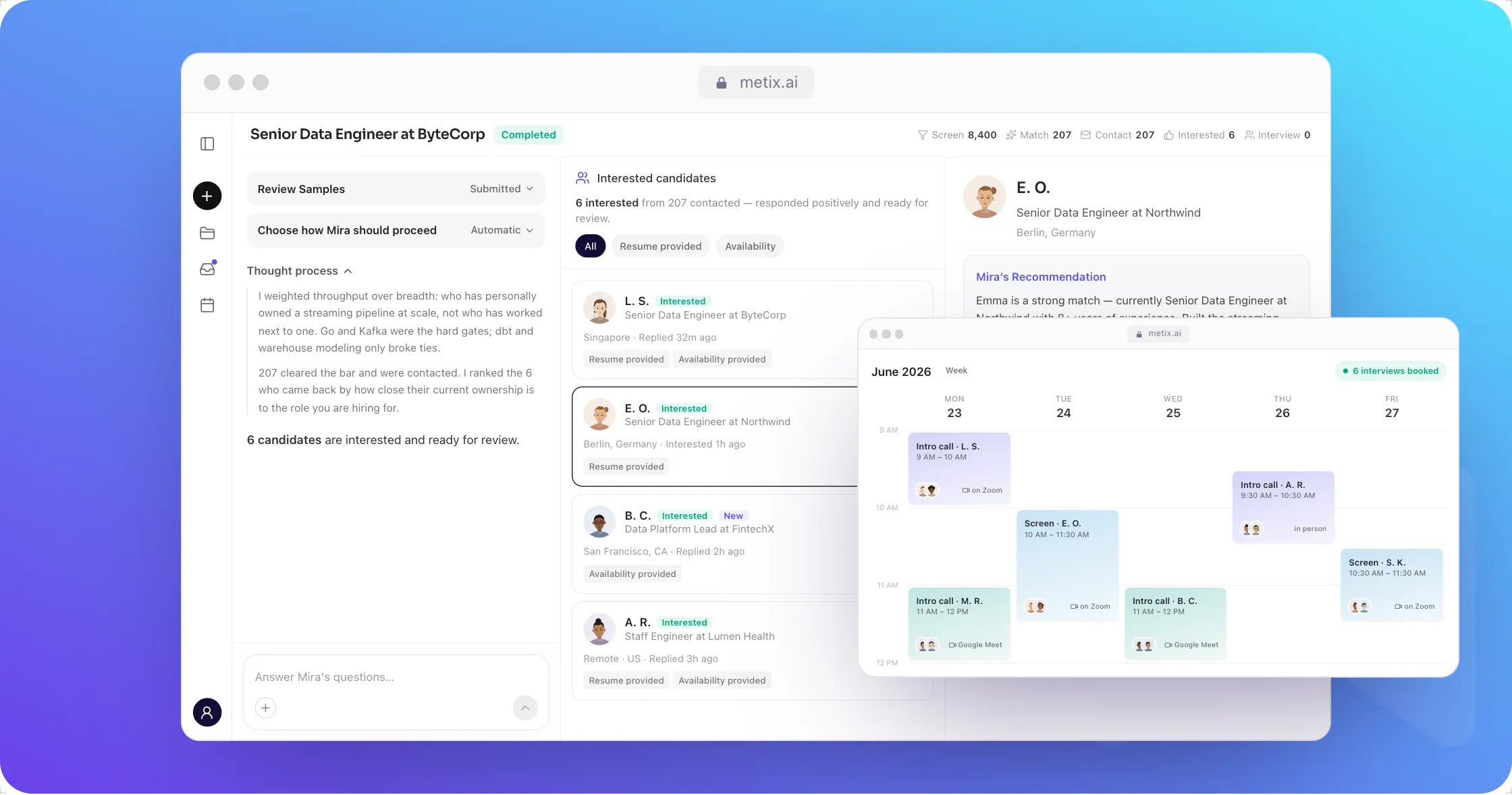
  2. 02 The search that never pauses Mira · continuous Sourcing across 860M+ profiles, replies handled the hour they arrive, screening against the bar you set. The stages that died in your gaps now run on a clock that is not yours. Every candidate passes a human review before you hear about them.
  3. 03 A delivery lead signs off Delivery team A person on our side checks each candidate against your bar before handoff. Someone who misses it never reaches you, and never costs a credit. Confirmed candidates book straight into your open slots.
  4. 04 You interview and decide You · the hire The conversations land as calendar blocks with the screening evidence attached. Decision, offer, and the hire itself never left your desk.
The split

What stays on your desk, stage by stage.

The design question behind Mira was never how to make a founder faster at recruiting. It was which parts of a search genuinely require the employer, and whether everything else can run without you. The published system report documents the five sub-agents that carry the middle.

Yours
Runs in the loop
Why the split lands there
Role brief
You write it once
Judgment about your own company. No system should invent it.
Sourcing
860M+ profiles, 190+ countries
Continuous work. The part that dies in the gaps.
Outreach
You approve every message
Sending, replies, follow-ups
Goes out under your name, so approval is a real checkpoint.
Screening
You set and move the bar
Runs against your bar
Judgment calls come back to you. The volume does not.
Scheduling
Booked onto your calendar
Booking removes the week three calendars spend agreeing by email.
Interviews and offer
Entirely yours
Yours, start to finish.
Owned Checkpoint Not involved
Side by side

Your real options, priced in hours.

There is a fourth option, a recruiting agency, and for senior searches it is often right; our fee analysis covers when. These are the three a founder actually weighs for most roles.

Metix AI
Run it in the gaps
Buy a sourcing seat
Who operates the loop
Mira plus a delivery lead
You, between other jobs
Still you, with better search
Your hours per week
Approvals and interviews
All of them, or the search stalls
All of them, minus search time
What a pause costs
Nothing: the loop keeps moving
Warm candidates go elsewhere
Same decay, nicer lists
What arrives
Booked, screened interviews
Whatever you got to this week
Profiles to work through
Cost shape
From $49/mo, spent per delivery
Free, paid in founder attention
Subscription, used or not
A month with no qualified candidates
Spends zero credits
Costs the weeks anyway
Invoice arrives regardless
Strong Partial Weak
What the loop has done so far

Early results, labeled as early.

24h
from brief to first interviews scheduled
95%
of roles hit that 24-hour window
~1wk
to fill, vs a commonly cited 45-day average

Drawn from the roles run for our early enterprise customers. Your numbers move with the role and the market, and we will tell you honestly what to expect for yours.

The risk shape

Priced for a company that cannot afford a failed experiment.

A retained search wants a five-figure engagement before any candidate exists. An annual seat wants twelve months of conviction about a tool nobody has hours to operate. The entry plan here is $49 a month: 3 interview-ready candidates against 1 active role, and a credit moves only when a qualified, interested candidate is booked. A month that delivers nobody worth meeting takes neither your money nor your attention. The outcome-pricing page walks the mechanics, including the boundary cases.

The $49 experiment.

Every credit is a candidate who cleared your bar, confirmed interest, and is booked for a first interview. No retainers. No seat you forget to cancel.

See pricing Starting at $49/mo
The boundary

When this is the wrong purchase.

Wrong purchase one

You have a recruiting owner

Someone on the team genuinely runs the search, keeps it moving, and needs better reach. Buy them a tool they operate; we keep a current shortlist, and most of it is not us.

Wrong purchase two

The search is the easy part

Some roles fill from your own network in a week. Paying for pipeline you already have is waste, and we would rather say so here than read it in a churn survey.

Wrong purchase three

You want an agency relationship

A human who takes the mandate end to end, manages the offer, and carries a placement guarantee is a different product at a different price. Our fee analysis lays out when it is worth it.

What remains is the situation this page is named for: real hiring need, no owner, no continuous hours, and a bar you are not willing to lower. That is the case we built for. The difference between a tool and this, spelled out mechanically, is in the sourcing-tool versus AI-recruiter comparison.

For the skeptics

The decay problem, in full.

A paused search does not wait for you

Every pause in a search has a cost that never appears on any invoice. During the week you spend on a product launch, three things happen to the search.

The warm replies cool. A response that sits for days signals exactly what it is: this company does not have its act together on hiring. The candidates you most wanted, the ones with options, are the first to read that signal and act on it.

Your own context evaporates. Which of the nine replies had the visa question? Who asked for the salary band? Rebuilding that state costs an hour before any new work starts, which raises the activation energy for the next session, which lengthens the next pause.

And the top of the funnel goes stale. Sourcing lists age; people change jobs and change their minds. Work done three weeks ago quietly stops being work you can use.

This is the founder hiring trap in one sentence: the search needs a continuous operator, the company has none, and every substitute for continuity, more tabs, better lists, a nicer tracker, fixes something other than the actual problem.

The candidate feels the fragmentation before you do. From their side of the table, a company that takes six days to answer an interested reply is indistinguishable from a company that is not serious about the role, and they calibrate their own risk accordingly. The smaller your company, the more the process itself is the pitch: it is the only evidence about how you operate that a stranger can see from outside.

The four things you keep have one property in common

Look back at the split table and notice what the four employer-side items share. None of them decays when your week explodes.

A brief written once stays written. An outreach approval takes minutes, not sessions, and it is a real checkpoint rather than a formality: every message goes out under your company's name, and the approval is the mechanism that keeps tone and claims in your control. The bar moves only because you moved it, as you learn the market. And the interviews land as scheduled blocks, which is how founders already work.

The continuous part, the part that was killing the search, is exactly the part that left your desk. That is the design criterion the system report is organized around: keep the employer where the judgment lives, and nowhere else.

The limit of the argument: we have not yet published stage-level measurements of where founder-run searches stall. When that data ships, it will appear here with its methodology, the same way every number on this site arrives.

Levers and arms, settled mechanically

The standard advice for a founder in this situation is to buy software: a sourcing tool, a seat on a professional network, an outreach platform with sequences. All of these are levers. None of them is an arm.

The mechanics are written up in the sourcing-tool versus AI-recruiter comparison, and they reduce to one question: after the tool does its part, who does the rest?

If that answer is the founder, the seat is a cost line with no operator attached, and the situation is unchanged. If the answer is a real person who owns the search, buy them the tool and skip us; that case is on the shortlist page, argued in the other direction.

The same test disposes of the agency question for most early roles. An agency gives you an arm, a very good one, priced for searches where the placement fee is small next to the cost of a wrong hire. For a founding team making its fifth hire, that price usually buys more certainty than the role needs, which is why the fee analysis, not this page, should make that call.

The test your calendar can run

Pick the search your calendar keeps killing. Write the brief once. Approve the outreach. Then let fourteen days decide it: either interviews land while you build, or they do not, and either way you will know at zero dollars, without lowering the bar to find out.

FAQ

Questions before you start.

How much time does a founder spend per week when Mira runs the search?

The employer-side work is four items: write and approve the role brief, approve the outreach that goes out under your name, keep the hiring bar current when Mira asks for a decision, and take the interviews. Everything between those points, sourcing, outreach, screening and scheduling, runs inside the loop. The interviews themselves remain the largest block, which is the point: the hours you spend are the hours only you can spend.

What does Metix AI cost for a company hiring one role?

The entry plan is $49 a month: 3 interview-ready candidates against 1 active role. A credit is spent when a qualified, interested candidate is booked, not when a profile is found or a message is sent. There is also a free 14-day trial with 3 New Roles and 12 Credits, no card required.

Do I need an ATS before using Metix AI?

No. Candidates arrive as booked first interviews with the screening evidence attached, so a calendar and an inbox are enough at the start. Teams that already run an ATS keep it; Metix AI is not an ATS and does not replace the system where you track applications, scorecards and offers.

What happens if no candidate clears the bar in a month?

Nothing is spent. Credits are only consumed when a candidate who clears your approved bar and confirms interest is booked. A delivery lead reviews every candidate before handoff, and a month with zero qualified candidates is a month with zero credits used.

The search keeps moving
while you build.

Write the brief once. Fourteen days, zero dollars, and the bar stays where you set it.

Free 14-day trial with 3 New Roles and 12 Credits. No card required.